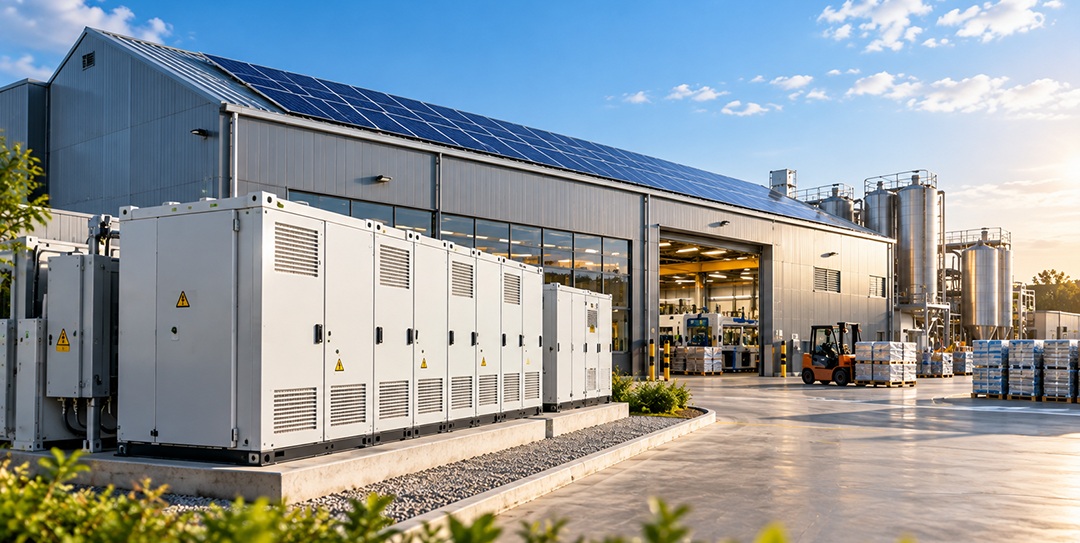
EWarehouses are no longer simply buildings where products are stored. Modern distribution and logistics facilities can operate around the clock, with automated handling systems, extensive lighting, refrigeration, security equipment, IT infrastructure and electric vehicle charging all contributing to their energy requirements.
As warehouse operations become more sophisticated, managing electricity effectively has become an increasingly important commercial consideration.
This is where battery storage for warehouses can provide a valuable opportunity.
A correctly designed battery energy storage system can give warehouse operators greater control over when electricity is generated, stored and consumed. It can work alongside rooftop solar, help manage periods of high demand, support electric vehicle charging and provide additional resilience for important operations.
Close Cooper Renewables provides commercial and industrial battery storage solutions designed to work around the specific requirements of individual sites. Its C&I storage solutions can capture excess on site generation, manage peak demand, support EV charging and provide backup capabilities where appropriately specified.
For warehouse operators considering their next energy investment, storage can therefore be more than simply another piece of equipment. It can become part of a wider strategy for managing the energy demands of the entire facility.
Why Warehouse Energy Demand Is Changing
The energy profile of a modern warehouse can be considerably more complex than it first appears.
Lighting may operate across large areas for extended periods. Conveyor systems, automated storage and retrieval equipment, sorting systems and other machinery can create significant electrical loads. Refrigerated warehouses have additional energy requirements, while security, communications and building management systems may operate continuously.
Then there are vehicles.
Warehouses and logistics centres increasingly use electric vans, forklifts, company cars and other electric vehicles. As charging infrastructure expands, electricity demand can increase significantly, particularly when several vehicles need to charge at the same time.
This means warehouse operators need to think beyond their total annual electricity consumption.
Understanding when electricity is being consumed can be just as important as understanding how much is being consumed.
Battery storage can provide flexibility by allowing electricity to be stored at one point in time and used later when it is more valuable to the business.
What Can Battery Storage for Warehouses Do?
At its simplest, a battery storage system stores electricity for later use.
However, commercial battery storage can perform several functions depending on how the system is designed and managed.
A warehouse could potentially use stored electricity to support demand during busy periods, capture surplus solar generation or help manage electricity purchased from the grid.
Where suitable tariff arrangements exist, batteries can also be charged during lower cost periods and discharged during more expensive periods.
Close Cooper Renewables’ C&I storage systems are designed around applications including peak demand management, time of use optimisation, solar integration, EV charging and backup.
This makes battery storage particularly relevant to warehouses because their energy requirements can change considerably throughout the day.
The important point is that the battery should be designed around the warehouse’s actual operating profile rather than selected purely according to its physical capacity.
Making Better Use of Warehouse Rooftops
Large warehouses often have substantial roof areas.
That creates an opportunity to install significant amounts of solar PV and turn otherwise unused roof space into a source of renewable electricity.
However, solar generation and warehouse electricity demand do not always perfectly coincide.
Solar panels can produce substantial amounts of electricity during the middle of the day, while the warehouse may have periods when demand is lower than the amount being generated.
At other times, the facility may need considerable electricity when solar generation is falling or has stopped altogether.
This is where battery storage can add another layer of flexibility.
Surplus solar electricity can potentially be stored rather than immediately exported. The stored electricity can then be used later when warehouse demand increases.
This can help businesses make greater use of their own renewable generation and reduce the amount of electricity they need to purchase from the grid.
Close Cooper Renewables already positions commercial solar and battery storage as an integrated energy solution, allowing businesses to consider generation and storage together rather than as completely separate investments.
Managing Peak Demand in Logistics Operations
Warehouse electricity demand can change rapidly.
A distribution centre might have several automated systems operating simultaneously. Refrigeration equipment may switch on, charging stations may be active and other electrical loads may increase at the same time.
These short periods of high demand can be important when assessing a site’s electricity requirements.
Battery storage can potentially discharge during suitable periods of high demand, reducing the amount of electricity being drawn from the grid at that moment.
This is commonly referred to as peak shaving.
The financial impact will depend on the warehouse’s electricity contract, tariff structure, demand profile and storage strategy, so businesses should avoid assuming a fixed level of saving before the system has been properly assessed.
Instead, historical energy data can be analysed to identify when demand peaks occur and whether battery storage could realistically help manage them.
Close Cooper Renewables states that its C&I storage solutions can smooth demand and help reduce peak charges through intelligent battery operation.
Supporting Electric Vehicle Charging
Electric vehicles are becoming increasingly important across logistics and warehouse operations.
A distribution centre may have electric delivery vans returning to the site throughout the day. Forklift fleets may also be transitioning from traditional power sources to electric alternatives.
As the number of electric vehicles increases, charging infrastructure can become a significant part of a warehouse’s electricity demand.
If multiple vehicles begin charging simultaneously, the additional load can put pressure on the site’s electrical infrastructure.
Battery storage can provide another way to manage this demand.
Stored electricity can potentially support EV charging during periods when grid demand is already high. Where solar PV is installed, solar generation can also contribute directly to charging during daylight hours.
This creates a connected energy system in which solar, battery storage, EV charging and warehouse operations can work together.
Close Cooper Renewables’ C&I storage solutions specifically support EV charging applications, including charging hubs and integrated solar storage charging configurations.
Improving Warehouse Energy Resilience
For many warehouses, electricity is essential to day to day operations.
A power interruption can affect lighting, refrigeration, security systems, automated equipment, communications and IT infrastructure. In a busy distribution operation, even a relatively short disruption can create operational complications.
Battery storage can form part of a wider resilience strategy when the system is specifically designed with backup functionality.
However, it is important to understand that not every commercial battery automatically provides whole site backup.
Backup performance depends on the equipment, electrical configuration, critical loads and overall project design.
A warehouse operator considering resilience should therefore identify which systems are genuinely critical.
For one facility, this might include refrigeration and security. For another, it could include automated handling systems, communications or specific areas of the building.
Close Cooper Renewables’ C&I storage solutions can be configured around backup priorities and critical systems where the project requirements support this application.
Connecting Storage With Energy Management
A warehouse battery is most effective when it is managed intelligently.
Simply installing a large battery does not automatically guarantee the best possible outcome. The system needs to know when charging and discharging makes sense according to the site’s energy requirements.
This is where an energy management system can become important.
Close Cooper Renewables describes its integrated energy management capabilities as being able to consider site loads, weather and tariffs when determining how the battery should operate. The system can support time of use schedules, peak shaving limits and backup priorities, with central monitoring available for multi site operations.
For a warehouse, this can mean the battery responds to the site’s actual operating conditions rather than following a basic fixed schedule.
For example, the system could potentially store surplus solar generation during a period of low warehouse demand and make that stored energy available later when demand increases.
This turns the battery into an active part of the warehouse’s energy strategy.
Choosing the Right Battery Size
One of the most important decisions when considering battery storage for warehouses is determining the appropriate system size.
Bigger is not automatically better.
The correct battery capacity depends on factors such as the warehouse’s electricity consumption, peak demand, solar generation, operating hours, tariff structure, EV charging requirements and backup objectives.
Power capacity is also important.
A warehouse may need a certain amount of battery energy capacity measured in kWh but it may also require sufficient power output measured in kW to respond to its peak loads.
These are different considerations.
Close Cooper Renewables notes that commercial battery sizing should take account of factors including load profiles, tariffs, peak demand and backup requirements, with interval data such as half hourly consumption helping to determine suitable power and energy capacity.
This data led approach can help businesses avoid investing in a system that does not properly match their operational requirements.
Considering Existing Electrical Infrastructure
Battery storage needs to work with the warehouse’s existing electrical infrastructure.
This becomes particularly important for facilities that have expanded over time.
A warehouse may have originally been designed around a relatively simple electricity requirement but later gained additional refrigeration, automation, solar PV, EV charging or other equipment.
Before installing storage, the existing electrical system should therefore be properly assessed.
The connection between the battery, solar installation, distribution equipment, grid connection and major electrical loads needs to be considered as part of the overall design.
Close Cooper Renewables’ C&I storage systems can be configured for different applications, including grid tied systems, microgrids and solar storage charging hubs.
This flexibility allows the installation to be considered in relation to the wider energy infrastructure rather than as an isolated battery project.
Battery Storage Can Support Future Warehouse Growth
Energy requirements rarely remain static.
A logistics company may increase its fleet of electric vehicles. A distribution centre may introduce additional automation. A refrigerated facility may expand its capacity. Warehouse operating hours may increase as the business grows.
These changes can significantly affect electricity demand.
When planning battery storage, it therefore makes sense to consider not only today’s energy profile but also likely future requirements.
The objective does not necessarily have to be installing the maximum possible capacity immediately.
Instead, the system design can consider whether future solar generation, battery capacity, EV charging or other energy technologies may be added later.
This can help create a more adaptable energy infrastructure.
For growing warehouse businesses, that flexibility can be particularly valuable because energy investments need to support operational expansion rather than become restrictive as requirements change.
Turning Warehouse Energy Into a Managed Asset
For years, energy in warehouses has largely been treated as an unavoidable operating expense.
Electricity is purchased, equipment consumes it and the business pays the bill.
Battery storage changes the conversation.
Instead of simply responding to electricity demand, a warehouse can potentially influence when it purchases, stores and consumes electricity.
Solar generation can provide renewable power.
Battery storage can provide flexibility.
Energy management can coordinate the different energy flows.
EV charging can be integrated into the wider strategy.
Together, these technologies can create a much more connected approach to warehouse energy.
The goal is not to make the warehouse more complicated. It is to make the energy system work more intelligently around the way the warehouse already operates.
Why Close Cooper Renewables?
Commercial battery storage needs to be designed around the individual business.
A warehouse has different requirements from a manufacturing plant, office or retail site. Even two warehouses can have completely different energy profiles depending on their size, operating hours, refrigeration, automation, solar generation and vehicle fleet.
Close Cooper Renewables works across commercial and industrial renewable energy projects, providing solutions that include solar PV, battery storage, C&I storage, EV charging, energy management and ongoing service and maintenance.
This wider capability allows warehouse operators to consider several energy technologies together.
For example, a business might already have rooftop solar and want to add battery storage. Another may be planning a new warehouse with solar, storage and EV charging from the beginning. A third may be primarily interested in managing peak demand and improving resilience.
Each situation requires a different approach.
The starting point should therefore be the warehouse itself, its energy consumption and the business objectives behind the investment.
A More Flexible Future for Warehouse Energy
Warehouses are becoming increasingly energy intensive and technologically advanced.
Automation, refrigeration, extended operating hours and electric vehicles are creating new demands on commercial electricity infrastructure. At the same time, businesses are looking for better ways to control costs, improve sustainability and make greater use of renewable energy.
Battery storage for warehouses can help address several of these challenges through one flexible energy technology.
It can store surplus solar generation, support periods of high demand, contribute to EV charging strategies and provide additional resilience where appropriate. When connected to an intelligent energy management system, it can also respond to changing conditions across the site.
The key is to design the system around the warehouse rather than trying to make the warehouse fit the battery.
A properly assessed and professionally installed solution can become part of a wider energy strategy that supports both today’s operations and tomorrow’s requirements.
For warehouse operators considering their next energy investment, battery storage offers an opportunity to move from simply consuming electricity to managing it more strategically.
Close Cooper Renewables can help businesses assess how solar, battery storage, EV charging and energy management can work together to create a more flexible and commercially focused energy system for their warehouse.