Energy has become an increasingly important consideration for businesses across the UK. Electricity is essential to almost every commercial operation, yet the way it is generated, purchased and consumed can have a significant impact on operating costs and long term planning.
For businesses with substantial or variable electricity demand, simply buying power from the grid when it is required may no longer provide the flexibility they need. Solar PV, battery storage, EV charging and intelligent energy management are changing the way organisations think about their energy infrastructure.
Commercial energy storage installation can play an important role in this transition.
A correctly designed battery storage system can allow a business to store electricity and use it at a more appropriate time. Depending on the site and its energy strategy, storage can support renewable generation, help manage periods of high demand, improve energy flexibility and contribute to greater resilience.
However, the value of commercial storage does not come from installing a battery alone. The installation needs to be designed around the way the business actually operates.
Close Cooper Renewables provides commercial and industrial battery storage solutions designed around individual business requirements, including applications such as excess generation capture, peak demand management and load stabilisation.
Why Commercial Energy Storage Is Becoming More Important
Every business has its own energy profile.
A manufacturing facility may use significant amounts of electricity when production equipment is running. A warehouse may have changing demand depending on operating hours, automation, refrigeration or lighting. A commercial office may experience its highest consumption during working hours.
These patterns matter because electricity demand is not constant.
There can be periods when a business uses relatively little electricity followed by short periods of significantly higher demand. At the same time, renewable generation such as solar PV is dependent on daylight and weather conditions.
This creates a gap between when electricity is generated and when it is required.
Battery storage provides a way of managing that gap.
Instead of using electricity immediately or exporting surplus renewable generation, a suitable battery system can store energy for later use. This can give businesses greater control over when electricity is available to their site.
The result is a more flexible energy strategy rather than a simple relationship between the business and the electricity grid.
Commercial Storage Starts With Understanding the Business
One of the most important parts of commercial energy storage installation happens before the battery arrives on site.
A professional installation should begin with an understanding of the business’s energy requirements.
This includes looking at electricity consumption, operating hours, periods of high demand, existing renewable generation, electrical infrastructure and future plans.
For example, a business operating several production shifts may have a very different storage requirement from a business that mainly operates during standard office hours.
Similarly, a warehouse planning to introduce a large fleet of electric vehicles may have very different future energy requirements from one without charging infrastructure.
This is why a standard battery package is not necessarily the right answer.
The objective should be to develop a storage system that reflects the business’s actual energy profile and commercial priorities.
Getting the Battery Size Right
Battery capacity is one of the most important considerations when planning commercial storage.
It can be tempting to assume that a larger battery will automatically provide greater benefits. In reality, the most appropriate system depends on what the business wants the battery to achieve.
A system designed primarily to capture excess solar generation may have different requirements from one designed to manage periods of high demand.
A business interested in supporting EV charging may need to consider another set of operational requirements. Similarly, an organisation that places a strong emphasis on resilience may need to consider how storage will interact with critical electrical loads.
Installing too little capacity may limit the potential benefits of the system. Installing substantially more capacity than the business needs could increase the initial investment without delivering proportional value.
Professional assessment is therefore essential.
Close Cooper Renewables takes a tailored approach to commercial and industrial storage, considering how the system can work alongside the wider energy requirements of the site.
Integrating Storage With Commercial Solar
For many businesses, battery storage makes particular sense when combined with solar PV.
Commercial buildings often have significant roof areas that can accommodate solar panels. During periods of strong sunlight, the system can generate electricity for use within the business.
However, solar generation does not always match the site’s electricity demand.
A business may generate surplus electricity during the middle of the day while its demand is relatively low. Later, when solar generation falls, the business may still require substantial amounts of electricity.
Battery storage can help bridge this gap.
Surplus solar electricity can potentially be stored and then used later when the business needs it. This can increase the proportion of renewable electricity consumed on site and reduce reliance on electricity purchased from the grid.
Close Cooper Renewables combines commercial solar and battery storage as part of integrated renewable energy solutions, helping businesses consider generation and storage as connected parts of their energy strategy.
Managing Periods of High Electricity Demand
Peak demand is another important consideration for commercial storage.
Many businesses have short periods when electricity consumption rises significantly. Several pieces of machinery may start at once, charging equipment may operate simultaneously or heating, cooling and other systems may create additional demand.
Depending on the business’s electricity arrangements, these periods can have an important effect on energy costs.
Battery storage can provide another source of electricity during suitable high demand periods. Rather than relying entirely on the grid, stored energy may be discharged to support the site’s requirements.
This approach is commonly known as peak shaving.
The potential financial benefit depends on factors such as the site’s electricity tariff, demand profile and battery operating strategy. For this reason, peak demand should be analysed as part of the overall system design rather than assumed to produce a particular saving.
The important point is that commercial storage can provide businesses with greater flexibility over when they draw electricity from the grid.
Supporting Business Energy Resilience
Energy costs are not the only consideration.
For many businesses, electricity is fundamental to day to day operations. A power interruption could affect manufacturing equipment, refrigeration, IT systems, security, warehouse automation or other critical processes.
Battery storage can form part of a wider resilience strategy where the system is specifically designed to support appropriate loads during an interruption.
This does not mean every commercial battery installation automatically provides whole site backup. Backup capability depends on the battery system, electrical infrastructure, critical loads and project design.
Businesses should therefore identify which systems are most important to maintain and discuss those requirements during the design stage.
Close Cooper Renewables highlights backup priorities among the potential applications of its C&I storage solutions.
Preparing for Electric Vehicle Charging
The growth of electric vehicles is creating another reason for businesses to consider energy storage.
Commercial fleets, employee vehicles, delivery vans and electric forklifts can all introduce additional electricity demand.
If multiple vehicles need to charge at the same time, the resulting demand can place additional pressure on a site’s electrical infrastructure.
Battery storage can potentially provide additional flexibility by supporting charging demand when appropriate.
This becomes particularly interesting when EV charging is combined with solar PV.
Solar electricity generated during the day can contribute towards charging, while stored electricity can potentially support demand when solar production is lower.
Close Cooper Renewables provides EV charging alongside commercial battery storage, solar PV and other renewable energy technologies, allowing businesses to consider charging requirements within a wider energy strategy.
Connecting Storage With Energy Management
A commercial battery is most useful when it operates according to a clear energy strategy.
This is where intelligent energy management becomes important.
Modern energy management systems can monitor factors such as site consumption, renewable generation, battery status and other energy conditions. Depending on the system, this information can be used to determine when the battery should charge or discharge.
Close Cooper Renewables’ commercial and industrial storage solutions include smart energy management capabilities that can take account of site loads, weather and tariffs, with support for automated battery dispatch, scheduling and peak shaving.
This can make the storage system considerably more responsive to the way the business operates.
Rather than treating the battery as a simple container for electricity, the business can make it part of a wider energy management strategy.
Considering the Existing Electrical Infrastructure
Commercial energy storage installation also needs to take account of the building’s existing electrical infrastructure.
The battery does not operate independently from the site’s electrical system. Its integration needs to be considered alongside existing distribution equipment, generation, loads and other electrical technologies.
This is particularly important for businesses with older infrastructure or sites that have undergone several stages of expansion.
A company may have added machinery, production areas, refrigeration, solar PV or EV charging over several years. The electrical infrastructure may therefore be more complex than the original building design suggests.
A professional assessment can help establish how a proposed battery system should integrate with the existing installation.
This is one of the reasons commercial storage should be treated as an infrastructure project rather than simply a product purchase.
Planning for Future Business Growth
Energy requirements can change as a business grows.
A company may add new production equipment, expand its premises, increase its operating hours or introduce electric vehicles. Solar capacity may also increase over time.
A storage system should therefore be considered within the context of future requirements where possible.
This does not necessarily mean installing everything immediately.
Instead, the initial system can be planned with future expansion in mind. Understanding where additional battery capacity, solar generation or EV charging could eventually fit can help businesses avoid unnecessary complications later.
A flexible energy strategy can be particularly valuable for growing organisations because the system can evolve alongside the business.
Commercial Energy Storage Is About More Than Cost Reduction
Reducing electricity costs is an important reason for considering storage but it should not be the only consideration.
A well designed system can potentially support several business objectives at the same time.
These can include:
– Improving the use of on site renewable generation
– Managing periods of high electricity demand
– Supporting EV charging infrastructure
– Increasing energy flexibility
– Improving resilience for selected critical loads
– Providing greater visibility over energy consumption
– Supporting longer term sustainability objectives
– Preparing the site for future energy requirements
The exact benefits will depend on the business, its energy profile and the design of the system.
This is why commercial energy storage installation should begin with a clear understanding of what the business wants to achieve.
Why Professional Installation Matters
Commercial battery storage is a significant investment in a business’s energy infrastructure.
The installation needs to be properly planned, correctly sized and integrated with the existing electrical system. Safety, accessibility, equipment location, system configuration and commissioning all need to be considered.
Ongoing servicing and maintenance are also important.
Energy storage is expected to operate for many years, so businesses should consider not only the initial installation but also how the system will be monitored and maintained throughout its working life.
Close Cooper Renewables provides renewable energy installation and ongoing service and maintenance, supporting businesses beyond the initial installation.
This can give businesses a more complete approach to managing their renewable energy infrastructure.
Why Choose Close Cooper Renewables?
Choosing the right commercial energy storage installer is about more than selecting a battery.
The installer needs to understand how the system will interact with the wider business environment.
Close Cooper Renewables works across commercial and industrial renewable energy projects, with services covering solar PV, battery storage, C&I storage, EV charging and energy management. It serves businesses across areas including Darlington, Northallerton, Stokesley, Barnard Castle, York, Ripon and Harrogate.
This wider range of expertise allows businesses to consider storage alongside other energy technologies.
For example, a company may already have solar panels and want to add a battery. Another may be planning solar, storage and EV charging as one project. A manufacturing business may be more interested in peak demand management and operational resilience.
The right solution will depend on the individual site.
Building a More Flexible Energy System
Commercial energy storage is becoming an increasingly important part of the way businesses approach electricity.
But the most valuable storage projects are not necessarily the ones with the biggest batteries.
They are the ones designed around a clear understanding of how the business generates, purchases and consumes energy.
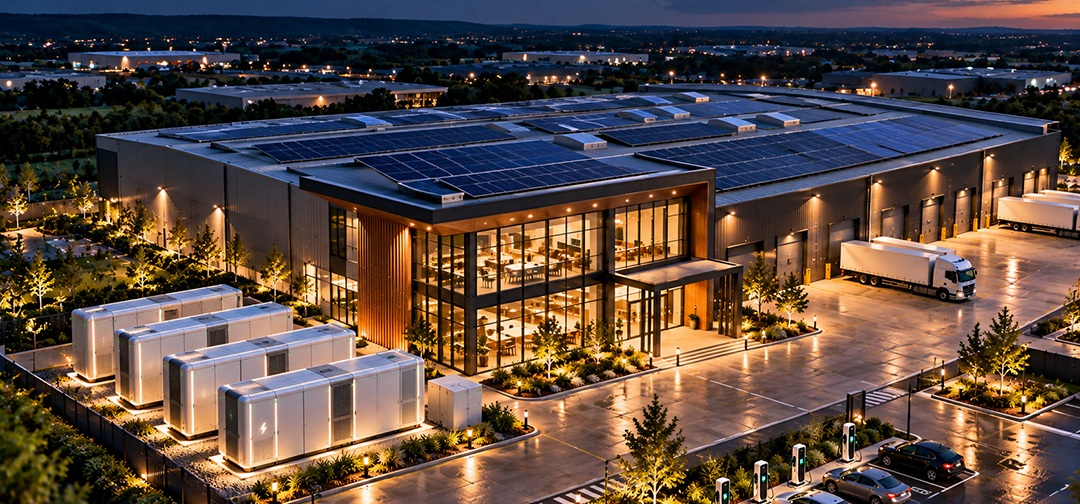
A successful commercial energy storage installation can connect several parts of a business’s energy strategy. Solar generation can provide renewable electricity, batteries can store surplus power, intelligent energy management can coordinate energy flows and EV charging can be integrated into the wider system.
This creates a more flexible approach to commercial energy.
Instead of simply responding to electricity demand as it occurs, businesses can gain greater control over when energy is generated, stored and consumed.
For organisations looking to improve energy efficiency, manage demand and make better use of renewable generation, that flexibility can become an important long term business asset.
Start With Your Energy Requirements
Every commercial property has a different energy profile.
Before investing in battery storage, businesses should understand how much electricity they use, when demand is highest, how much renewable energy they generate and what their future requirements could look like.
From there, the right storage capacity, operating strategy and supporting technologies can be assessed.
Close Cooper Renewables can help businesses explore commercial battery storage as part of a wider renewable energy strategy, with solutions designed around the requirements of individual sites.
If your business is considering commercial energy storage installation, understanding the opportunity starts with your existing energy use. From there, a professionally designed storage system can help turn that information into a more flexible, connected and future ready energy strategy.